
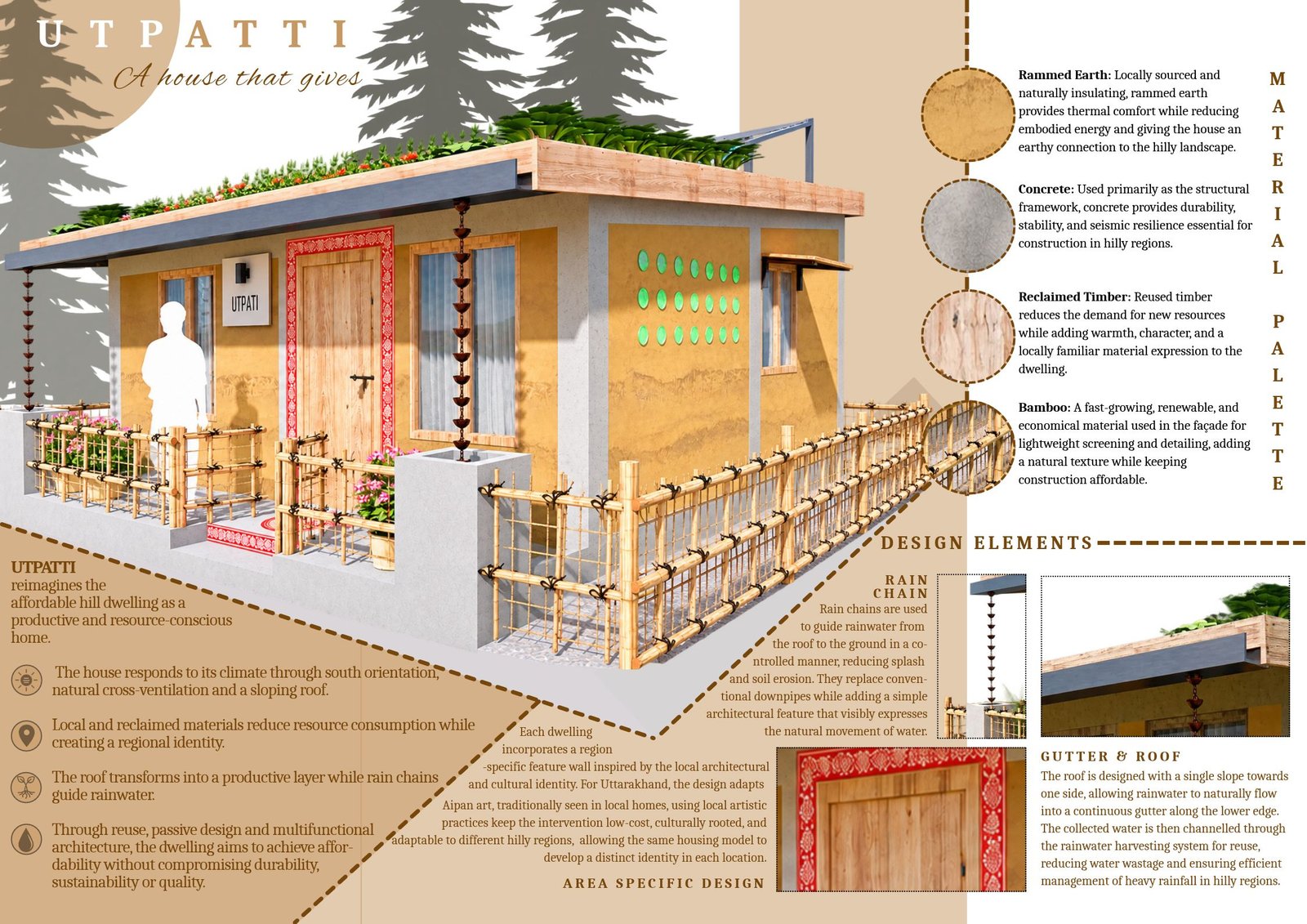
By Ar. Nitin Pande | Principal Architect, Pande & Associates
Architecture has traditionally been judged by its appearance, functionality, structural integrity and relationship with its surroundings. In recent decades, sustainability has added another important measure: how responsibly a building consumes resources and affects the environment. But is reducing environmental harm enough? At Pande & Associates, we believe the next important conversation in architecture must move beyond buildings that consume less towards buildings and environments that contribute more. This is the central idea behind our approach to Productive Architecture.
Beyond Sustainability: From Less Harm to Greater Value
Sustainable architecture commonly focuses on reducing energy consumption, conserving water, selecting responsible materials, improving indoor environmental quality and minimising waste. These objectives remain essential. However, a building can be environmentally efficient and still contribute relatively little to its wider surroundings. Productive Architecture asks an additional question: What positive value can a building create throughout its life? That value may be environmental, social, economic, cultural or operational. A building might generate renewable energy, support vegetation, facilitate rainwater harvesting, improve working conditions, accommodate changing uses or create opportunities for community interaction. The ambition is not simply to reduce what architecture takes from its environment, but to explore what architecture can meaningfully return.
The Five Dimensions of Productive Architecture
1. Environmental Productivity:
Buildings should explore Opportunities to work with natural systems rather than remain entirely dependent on mechanical ones. Passive cooling, daylight, responsible water management renewable energy and integrated landscapes can contribute towards more resource- concious environments. the appropriate combination depends on climate, location, building use and technical feasibility.
2. Social Productivity
Architecture shapes relationships between people. A school can encourage learning beyond the classroom. A public building can become an accessible civic destination. A residential development can support shared spaces and stronger community interaction. Social productivity begins when architecture considers the people affected by a building, including those who may never own or operate it.
3. Economic and Operational Productivity
A productive building must also perform effectively. In industrial architecture, this may involve efficient circulation, logical material movement, flexible manufacturing areas, safer access and provision for future expansion. In commercial architecture, it may involve adaptable floor plates, efficient services and spaces that respond to changing patterns of use. Good design should support long-term usefulness, not merely initial visual impact.
4. Cultural Productivity
Buildings can preserve and reinterpret cultural knowledge. Regional materials, local craftsmanship, traditional spatial arrangements and meaningful architectural symbols can create continuity between past and future. Architecture becomes culturally productive when it allows identity and memory to remain relevant to contemporary life.
5. Long-Term Productivity
Buildings outlive the circumstances in which they were conceived. Their ability to adapt, accommodate new technologies, support changing users and remain maintainable over time is a significant part of their value. An adaptable building can potentially avoid premature replacement and the associated consumption of resources.
How Productive Architecture Applies to Different Building Types
Productive Architecture is not limited to one architectural category.
In industrial projects, it can mean creating an efficient relationship between people, production, movement and infrastructure.
In educational buildings, it can mean using circulation, courtyards and shared areas to extend opportunities for learning.
In hospitality projects, it can mean integrating buildings with landscape, local culture and regional economic activity.
In memorial architecture, it can mean transforming remembrance into continuing public usefulness through learning, gathering and shared experience.
In urban design, it can mean exploring how public spaces, vegetation, movement networks and environmental infrastructure contribute to healthier cities.
The common principle is that architecture should be evaluated through its contribution as well as its composition.
Productive Architecture Is an Ambition, Not an Automatic Certification
It is important to distinguish an architectural philosophy from a verified performance outcome. A building does not become environmentally positive simply because it contains greenery or solar panels. Claims relating to energy generation, carbon reduction, air purification, water savings or ecological benefits require appropriate calculations, monitoring and evidence. For us, Productive Architecture provides a framework for asking better design questions. Its success must ultimately be assessed through the performance and usefulness of the resulting spaces.
Our Architectural Philosophy
At Pande & Associates, a multidisciplinary architectural practice established in 1968, Productive Architecture represents our continuing exploration of buildings and environments that contribute more than they consume. Led by Principal Architect Ar. Nitin Pande, our approach seeks to integrate environmental responsibility, human wellbeing, cultural continuity, operational efficiency and long-term adaptability into meaningful architectural solutions.
Architecture should not merely occupy space. It should create value for people, places and future generations.
Frequently Asked Questions
What is Productive Architecture?
Productive Architecture is a design approach that seeks to create measurable or meaningful positive value through buildings and environments, including environmental, social, operational, cultural and long-term benefits.
How is Productive Architecture different from sustainable architecture?
Sustainable architecture generally prioritises responsible resource use and reduced environmental impact. Productive Architecture builds on these principles by asking how buildings can also create additional positive value.
Can existing buildings become more productive?
Yes. Adaptive reuse, energy upgrades, improved accessibility, better space utilisation and landscape integration can help existing buildings contribute more effectively.
Is Productive Architecture suitable for industrial and commercial projects?
Yes. Operational efficiency, user comfort, adaptability, resource management and long-term functionality are important aspects of productive industrial and commercial design.
About the Author
Ar. Nitin Pande is Principal Architect at Pande & Associates, an architectural and interior design practice established in 1968 and based in Noida, India. The practice works across residential, industrial, institutional, hospitality, commercial, landscape and public architecture.
Explore: https://www.pandeassociates.in/about